Between the dense sands of the Victorian District and the soft marsh-edge clays near Thunderbolt, the ground beneath Savannah shifts dramatically within just a few blocks. After opening dozens of pits across Chatham County, our team has seen firsthand how the Pleistocene terrace deposits and recent alluvial fills create two entirely different excavation behaviors less than a mile apart. An exploratory test pit lets you see the stratigraphy directly, measure the seasonal water table at roughly 4 to 7 feet below grade, and decide on foundation depths before the backhoe even leaves the site. When the IBC requires a bearing stratum verified by visual inspection, this method delivers answers that a drill rig alone cannot, especially where the SPT drilling data needs ground-truthing against what the eye can confirm.
Opening a test pit in the Coastal Plain means confronting the water table directly — if you cannot control it, you cannot log it accurately.
Process and scope
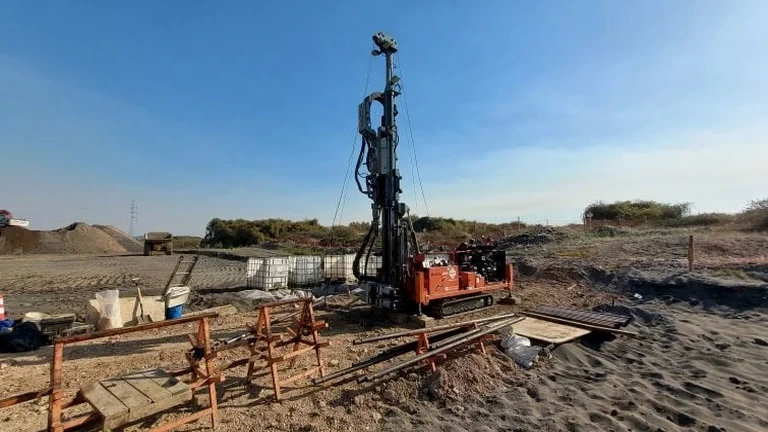
Local ground factors
A visual-only assessment from drill cuttings proves inadequate for the soil classification mandated by IBC Section 1803 in Savannah's low-lying properties, especially those within the FEMA AE flood zone covering much of the city south of Bay Street. An excavated pit provides an uninterrupted exposure where narrow layers of decayed vegetation, former topsoil, or historical wetland sediments become readily apparent. In the Starland District, we have encountered unrecorded fill strata containing fragments of brick and oyster shell only three feet beneath the surface—material that would be missed in a conventional SPT sampler. Overlooking such lenses can lead to reports of uneven settling within the initial two years of occupancy. Moreover, for properties situated in the 100-year flood zone, the pit also records the peak seasonal water table, which directly impacts foundation design and the requirement for sub-slab drainage as stipulated by ASCE 7 flood provisions.
Video overview
Reference standards
Geotechnical investigations must adhere to IBC Section 1803, while soil classification follows ASTM D2487 and ASTM D2488, and site classification is per ASCE 7-22 Chapter 20.
Other technical services
Standard Exploratory Pit
For single-family residential lots in the Ardsley Park and Parkside neighborhoods, where bearing sands are anticipated, a single pit excavated to a maximum depth of 12 feet is employed. The pit includes a stratigraphic log in accordance with ASTM D2488, Munsell color notation, moisture condition evaluation, and photographic documentation of all exposed faces.
Instrumented Test Pit Program
For commercial developments that need IBC special inspection documentation, a grid pattern of multiple pits is utilized. These pits undergo in-situ density testing using a drive ring, pocket penetrometer, and torvane readings for each lift, along with groundwater monitoring spanning a 48-hour recovery period.
Forensic Exposure and Fill Verification
Pits are strategically placed to reveal existing footings, confirm the thickness of unrecorded fill, or examine signs of distress. The process encompasses sampling for laboratory classification and a written assessment of fill suitability in accordance with Chatham County's grading requirements.
Typical parameters
Frequently asked questions
What does an exploratory test pit cost in Savannah?
In the Savannah region, anticipate a cost ranging from US$550 to US$810 for a standard test pit. This variation reflects mobilization distances across Chatham County, the chosen depth (usually between 8 and 14 feet), and the need for groundwater pumping during logging. When multiple pits are scheduled on a single site, the per-pit expense decreases since the backhoe and field team are already present.
How deep can a test pit go in Savannah before the water table becomes a problem?
The surficial water table in central Savannah lies at depths ranging from 4 to 7 feet beneath the surface. Excavations below this level necessitate ongoing dewatering using a trash pump. A typical backhoe allows logging to around 14 feet, but once the excavation depth surpasses 5 feet, OSHA safety regulations require benching or sloping of the face.
Do I still need drill rig borings if I have test pits?
Drill borings and test pits play complementary functions. An excavated pit offers an uninterrupted visual section, enabling identification of narrow strata, fill deposits, and the precise water table level. Conversely, SPT borings deliver blow count information at deeper elevations and permit laboratory examination of undisturbed specimens. For the majority of commercial developments in Savannah, we advise incorporating at least one test pit alongside a boring program to meet both IBC visual classification requirements and the need for deeper bearing capacity assessment.
How quickly can a test pit be scheduled and backfilled in Savannah?
Most residential test pits are excavated, logged, photographed, and backfilled within a single morning, typically 3 to 4 hours on site. We schedule early starts to beat the afternoon thunderstorms common in the Coastal Plain from May through September. Backfill is compacted in lifts with the excavator bucket, and the surface is restored to grade. A written log with photos is delivered within 48 hours. More info.