The International Building Code and ASCE 7 require a thorough geotechnical investigation before any structure rises in Savannah. ASTM D1586 governs the Standard Penetration Test, and in this city, the procedure faces a unique adversary: the Atlantic Coastal Plain. Beneath the live oaks and historic squares, the subsurface transitions rapidly from loose sands to stiff marl and Cooper Marl, often with groundwater within five feet of the surface. A routine SPT boring here tells a complex story. Our technical team runs the split-spoon sampler with a 140-pound hammer dropping 30 inches, recording blow counts every six inches. That raw data, combined with proper sampling technique, is what separates a foundation that settles predictably from one that cracks the brickwork on a Bull Street townhouse. For deeper profiling in soft zones, we often pair the SPT with a CPT test to catch thin clay seams the spoon might miss.
In coastal Georgia, an uncorrected N-value can be dangerously optimistic. We apply overburden and energy corrections to get the true soil behavior.
Process and scope
Local ground factors
Savannah sits on unconsolidated Quaternary and Tertiary sediments that thicken toward the coast. The upper 20 to 40 feet often contain loose to medium-dense sands interbedded with soft clay lenses, a profile that demands rigorous liquefaction screening under ASCE 7-22. During the 1886 Charleston earthquake, ground failure and sand blows were reported as far south as the Savannah River basin, and modern probabilistic maps place the area in a moderate seismic hazard zone. A single inaccurate N-value in a loose sand at 15 feet can flip a liquefaction analysis from 'low risk' to 'high risk,' triggering costly ground improvement. Our reports provide the corrected N1(60) values needed for the simplified procedure by Youd and Idriss, giving the structural engineer a defensible basis for either ruling out liquefaction or designing mitigation like stone columns or deep foundations.
Video overview
Reference standards
The following standards govern our work: ASTM D1586-18 (Standard Penetration Test and Split-Barrel Sampling), ASTM D2487-17 (Unified Soil Classification System), ASCE 7-22 (Chapter 20 for Seismic Site Classification), and the 2021 International Building Code's Section 1803 on Geotechnical Investigations.
Other technical services
SPT Drilling and Sampling
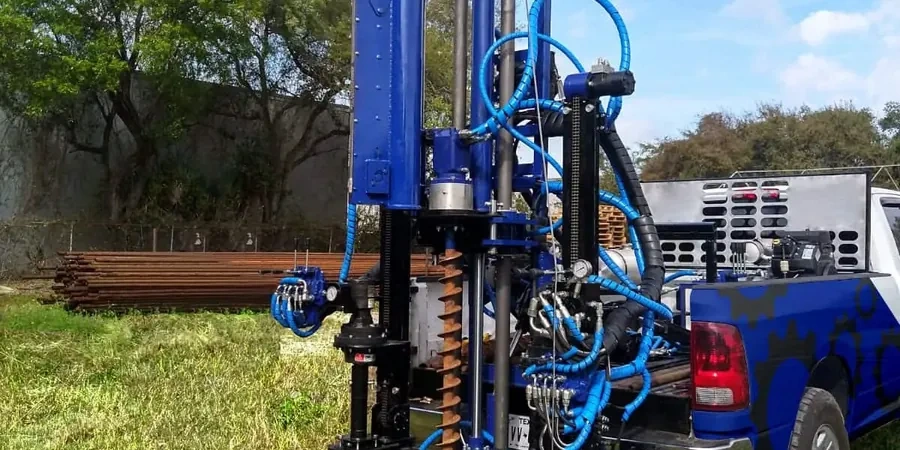
For advancing borings through coastal plain soils, we employ truck-mounted or limited-access rigs using hollow-stem augers or mud rotary methods. A field geologist is present at every boring to record N-values, retrieve split-spoon samples, and log the stratigraphy.
Laboratory Testing and Reporting
Selected SPT samples undergo classification tests (grain size and Atterberg limits), and we correlate N-values with strength and compressibility. The final deliverable includes boring logs, site classification per ASCE 7, and foundation recommendations for either shallow or deep systems.
Typical parameters
Frequently asked questions
How much does an SPT boring cost in Savannah?
For a standard SPT boring in the Savannah metro area, anticipate costs between US$470 and US$650 per hole, provided a truck-mounted rig can access the site. The final figure hinges on depth, mobilization distance, and the total number of borings. A single 50-foot deep boring falls at the higher end, whereas multiple borings on a clear lot may reduce each hole's cost.
What depth do you typically drill for a residential foundation investigation?
For single-family homes or townhouses in Savannah, we typically advance SPT borings to at least 25 to 30 feet, or until we hit competent bearing material with consistent N-values exceeding 15. If the design includes a basement or if soft organic silts appear in the upper profile, we extend the boring to assess the compressible layer's thickness and confirm the depth to the Cooper Marl when present.
How do you handle the high groundwater table during SPT sampling?
Given Savannah's shallow groundwater—often just three to five feet below the surface—we use mud rotary or hollow-stem auger techniques to keep the borehole stable. Drilling mud or continuous auger flights balance hydrostatic pressure and prevent sand heave into the casing. Without these measures, the SPT could yield artificially low blow counts in loose saturated sands, compromising liquefaction assessments and settlement calculations.