IBC Chapter 18 and ASCE 7 govern deep excavation design across Georgia, but Savannah imposes unique demands. The city sits on Pleistocene and Holocene coastal terrace deposits — loose sands, soft clays, and marl layers that shift under stress. Groundwater sits barely 1.5 meters below the surface across much of Chatham County. Any cut deeper than 3 meters must account for rapid base heave and low passive resistance. Our team runs site-specific soil characterization per ASTM D2487 and integrates in-situ permeability tests for dewatering system sizing before a single soldier pile goes in. The Savannah River's alluvial influence complicates the stratigraphy further. We pair triaxial testing with undrained strength profiles for the soft clays that govern wall embedment depth.
Savannah's groundwater at 1.5 meters depth turns a 4-meter cut into a continuous dewatering operation — design without permeability data is just guessing.
Process and scope
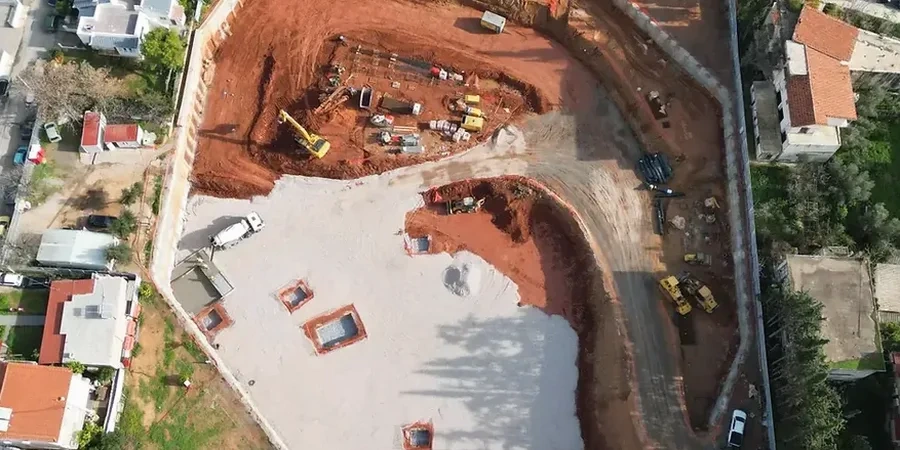
Local ground factors
Dewatering failure poses a major risk—if a single pump stops working overnight, the excavation may flood and the passive zone can erode. To prevent this, we specify dual-redundant wellpoint systems equipped with automatic float switches. The last major seismic event felt in Savannah was the 1886 Charleston earthquake (magnitude 7.0), and USGS hazard maps for Chatham County document liquefaction potential in the loose coastal sands. For deep excavations, failing to account for seismic earth pressures could lead to wall failure during a similar event. Base heave in soft clays is another critical concern; we compute the factor of safety against basal heave using Terzaghi's method and verify with Bjerrum and Eide for narrow cuts. Tieback anchors in sand layers must be designed for post-liquefaction strength loss to maintain capacity. Our designs adhere to a minimum factor of safety of 1.5 for static conditions and 1.1 for seismic cases per ASCE 7-22.
Reference standards
The following standards and guidelines are applied: IBC 2021 Chapter 18 for Soils and Foundations, ASCE 7-22 for Minimum Design Loads on Buildings, ASTM D2487 for the Unified Soil Classification System, ASTM D1586 for the Standard Penetration Test, FHWA GEC No. 4 for Ground Anchors and Anchored Systems, and FHWA NHI-05 for Soil Nail Walls.
Other technical services
Shoring Wall Design
Excavation support systems up to 15 meters deep are designed as cantilever, anchored, or braced walls. Depending on soil retention needs and groundwater control in Savannah's coastal deposits, wall sections use either sheet piles or soldier beams with timber lagging.
Dewatering and Base Stability Analysis
Deep well and wellpoint dewatering layouts are sized based on field permeability tests. We calculate basal heave factors of safety and, where the soft Savannah clays cannot support the excavation base without assistance, we design jet grout plugs or deep soil mixing reinforcement.
Construction-Phase Monitoring Plan
Monitoring specifications include instrumented systems: inclinometers behind the wall, piezometers for pore pressure, and optical survey points on adjacent structures. Trigger levels are directly linked to design assumptions so that contractors can take immediate action.
Typical parameters
Frequently asked questions
What dewatering method works best for Savannah's high groundwater during deep excavation?
For excavations exceeding 5 meters in downtown Savannah, we typically specify a deep well system with submersible pumps. For shallower work, a single-stage wellpoint system around the perimeter handles the 1.5-meter water table. The design always incorporates a backup pump on a separate power circuit and a standby generator connection.
How much does a geotechnical design package for a deep excavation in Savannah cost?
Depending on excavation depth, wall length, and subsurface complexity, a complete design package—including site investigation plan, shoring wall calculations, dewatering design, and sealed construction drawings—ranges from US$2,010 to US$8,270.
Do Savannah excavation designs need to consider seismic loading?
Yes. Although Savannah is not in a high-seismicity zone, the 1886 Charleston earthquake showed that strong ground motion can affect the coastal plain. ASCE 7-22 mandates seismic earth pressure checks for permanent retaining walls and any excavation open longer than six months. We perform pseudostatic analysis with a minimum horizontal coefficient of 0.1g in the design.