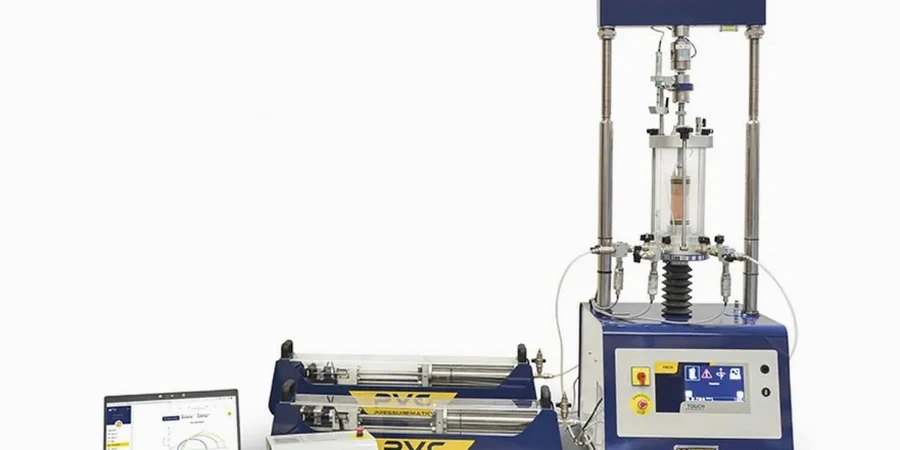
Triaxial testing provides effective stress parameters that standard penetration tests cannot, measuring cohesion and internal friction under controlled confining pressures. For Savannah projects, such tests were crucial during the 2021 Georgia Ports Authority terminal expansion, which handled over 5.5 million TEUs, to establish drained friction angles for dense sands beneath new berths. The city's subsurface reflects Pleistocene coastline history, with marine terraces and alluvial fills forming distinct geomechanical units that vary within a few blocks. On the silty clays of the Savannah Formation or loose sands of the Wicomico terrace, we employ both consolidated-undrained (CU) and drained (CD) protocols to capture stress-strain behavior governing foundation performance. The resulting Mohr–Coulomb failure envelopes directly inform bearing capacity calculations and excavation support design, replacing conservative assumptions with site-specific strength curves.
Effective stress parameters from a triaxial test turn a generic safety factor into a defensible design value that accounts for Savannah’s layered Pleistocene stratigraphy.
Process and scope
Local ground factors
A common mistake in Savannah geotechnical reports is using total stress parameters from unconfined compression tests for long-term slope stability analysis. The low plasticity clays of the Savannah River floodplain lose significant undrained shear strength as pore pressures equalize post-construction, a condition unconfined tests cannot replicate. Drained triaxial tests with pore pressure measurement reveal the effective friction angle controlling long-term stability, often 2 to 4 degrees lower than total stress interpretations. For river-side excavations deeper than 15 feet, where tidal fluctuations cause daily pore pressure cycles, specifying CU triaxial tests with pore pressure measurement is the sole method to model both short-term construction and long-term equilibrium in one test program.
Reference standards
For cohesive soils, the relevant ASTM standards include D4767 for consolidated undrained triaxial testing, D2850 for unconsolidated undrained, and D7181 for consolidated drained triaxial compression tests on soils.
Other technical services
CU Triaxial with Pore Pressure Measurement
For Savannah clays ranging from soft to stiff, consolidated-undrained tests per ASTM D4767 use three effective confining pressures to produce a Mohr–Coulomb envelope with c′ and φ′. The procedure incorporates B-check saturation verification and post-shear water content profiling.
Drained Triaxial for Granular Soils
When testing reconstituted or intact sand samples from Savannah's Pleistocene terraces, we follow ASTM D7181 for consolidated drained (CD) testing. A slow shear rate maintains drained conditions, and volume change measurements yield dilatancy angles for advanced constitutive models.
Typical parameters
Frequently asked questions
When does a Savannah project need CU instead of UU triaxial testing?
Effective stress parameters for long-term stability analysis, such as for cut slopes along I-16 or deep excavations in Hawthorne Group clays, require consolidated-undrained (CU) testing per ASTM D4767. Unconsolidated-undrained (UU) per ASTM D2850 provides total stress parameters only suitable for short-term end-of-construction conditions under rapid loading.
How many specimens are needed for a complete triaxial test program?
Constructing a complete Mohr–Coulomb envelope requires shearing three specimens at different confining pressures, typically 5, 10, and 20 psi for Savannah projects. We also recommend one extra specimen as backup in case of sample disturbance during extrusion.
What sample quality is needed for triaxial testing on Savannah clays?
Sampling requires undisturbed Shelby tubes with a recovery ratio above 90% and an area ratio below 10%. Field samples are wax-sealed immediately and transported upright. We process specimens within 24 hours of extraction to minimize moisture loss in Savannah's summer humidity.
Can triaxial testing be performed on sands from Savannah’s upper coastal plain?
Reconstituted specimens are prepared to match field density measured by sand cone or nuclear gauge. Drained triaxial tests on these sands capture the dilative peak friction angle, essential for foundation design on the Wicomico and Penholoway terraces west of Savannah.
What does a triaxial test program cost for a typical Savannah commercial project?
A complete three-stage CU triaxial suite with pore pressure measurement ranges from $2,150 to $2,330, depending on specimen preparation time and whether drained tests on sand layers are included. The investment typically reduces foundation over-design costs by clarifying actual strength parameters. More info.