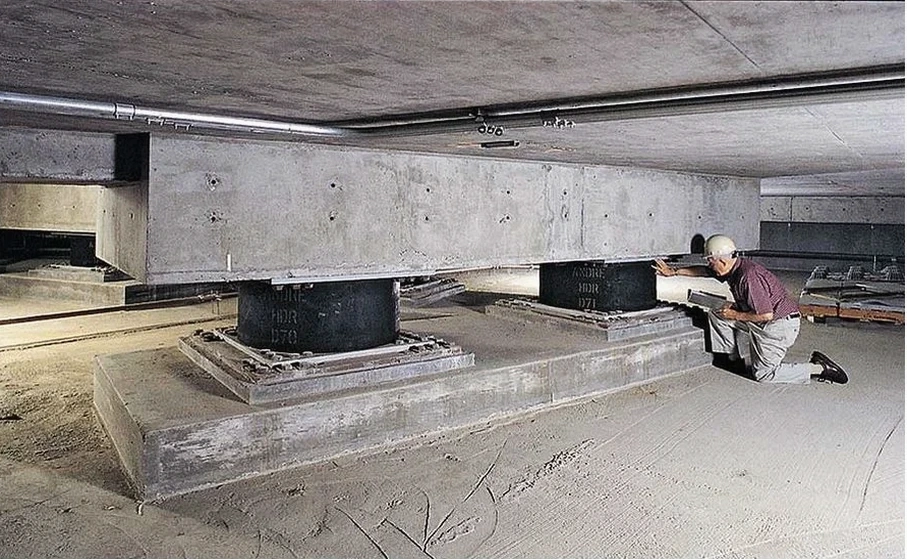
We have seen too many renovation projects in Savannah's Historic District where the structural engineer assumes a fixed-base model will suffice, only to discover during a seismic microzonation review that the site sits on Class E or F soils. That assumption can trigger a costly redesign and, worse, leave a landmark building vulnerable. Savannah sits at roughly 32 degrees north latitude with deep deposits of soft alluvial and marine sediments along the Savannah River and coastal plain; these soils amplify long-period ground motion in ways that conventional framing cannot always handle. Base isolation seismic design changes the equation: instead of strengthening the superstructure to resist every lateral force, you decouple it from the ground. The team here applies that principle to new construction and seismic retrofits alike, using lead-rubber bearings, high-damping rubber isolators, or friction pendulum systems depending on the building period and the geotechnical profile underneath. Every design starts with a site-specific response spectrum per ASCE 7-22 Chapter 17, not a canned solution copied from a different geology.
Decoupling a Savannah building from soft coastal soils shifts the fundamental period past two seconds, cutting spectral acceleration demand by more than half.
Process and scope
Local ground factors
Savannah's population now exceeds 148,000, and the Georgia coast lies within the influence zone of the Charleston seismic source. In 1886, that source generated an estimated magnitude 7.3 earthquake that damaged structures as far as Tybee Island. A similar event today, coupled with the deep Coastal Plain sediments that amplify long-period energy, could produce lateral displacements of 18 to 24 inches on a fixed-base mid-rise building. Base isolation seismic design directly addresses this risk by allowing displacement at the isolation plane while keeping the superstructure nearly elastic. The primary threat in Savannah is not collapse but functional loss. A conventionally designed hospital or emergency operations center might remain structurally intact but lose ceilings, MEP systems, and elevator rails, rendering it unusable when most needed. Isolated buildings prevent this cascade of nonstructural damage. Moisture is another risk: the isolation plane is near the water table in many Savannah locations, so we specify a drained moat with sump pumps and corrosion-resistant isolator components. Omitting these details reduces bearing service life and can lock the isolation system when movement is required.
Reference standards
Applicable codes and standards include ASTM D4014 for elastomeric bearings, ASCE/SEI 7-22 Chapter 17 for seismic isolation requirements, IBC 2024 §1705.13 for special inspection of isolators, ASCE/COPRI 61-14 for seismic design of coastal structures such as piers and wharves, and the AASHTO Guide Specifications for seismic isolation design in bridge applications.
Other technical services
Feasibility Study & Concept Design
The scope covers developing a site-specific response spectrum using Savannah borehole data, selecting between LRB and FPS isolator types, creating a preliminary moat and foundation layout, comparing costs with fixed-base alternatives, and providing a go/no-go recommendation to the project team.
Final Design & Construction Support
Services include nonlinear time-history analysis using ETABS or SAP2000, specifying prototype testing per ASCE 7 §17.8, reviewing isolator shop drawings, designing moat waterproofing and drainage for high water table conditions, and conducting periodic site visits during isolator installation and moat construction.
Typical parameters
Frequently asked questions
At what building height or risk category does base isolation become worth evaluating in Savannah?
Evaluation typically begins at two stories for Risk Category III and IV structures (hospitals, emergency centers, schools) and above six stories for Category II residential or office buildings. The soft soil profile prevalent in Savannah makes the period-shift benefit significant even at moderate heights.
How does the high water table in Savannah affect the isolation system?
The moat must be waterproofed as a drained, habitable space. Our design uses a reinforced concrete moat wall with crystalline waterproofing admixture, a perimeter drainage board, and dual sump pumps. Isolator components exposed to humidity are specified with stainless steel shims and coatings tested for continuous damp service.
What is the typical cost range for base isolation design in the Savannah area?
For a mid-rise building in the 40,000 to 80,000 square foot range, the design fee for full base isolation engineering services (feasibility through construction support) typically ranges from US$4,130 to US$8,910, depending on the number of isolator types evaluated and the peer review requirements.
Do you perform the prototype testing or just specify it?
We write the test specification per ASCE 7 §17.8 and review the test reports, but the testing itself is performed by an independent laboratory on isolator prototypes fabricated by the manufacturer. Whenever possible, we attend the first day of testing.
Can base isolation be added to an existing historic masonry building in Savannah?
Yes, such retrofits have been done elsewhere. The process involves temporarily supporting the structure on jack piles, cutting the existing foundation, and installing isolators. For Savannah's historic masonry, the challenge is the low compressive strength of lime-based mortar, so a detailed structural assessment of the load path is critical before proceeding.