ASTM D2487 classification isn't just paperwork when you're boring through Savannah's upper coastal plain sediments. The city sits on a complex layering of Pleistocene and Holocene deposits, with the water table often just four to six feet below the surface thanks to the proximity of the Savannah River and the Atlantic Ocean. Our laboratory team processes undisturbed Shelby tube samples from tunnel alignments across Chatham County, and we've seen firsthand how the interbedded sands and clays of the Hawthorne and Duplin formations behave under load. For tunnel design through these materials, you absolutely need to know whether you're dealing with SM, SC, or CH soils, because the face stability calculations depend entirely on that classification. We run the full suite of index and strength tests to support triaxial testing when the alignment crosses under the historic district, where settlement tolerances are measured in fractions of an inch.
Savannah's upper coastal plain sediments require face stability analysis that accounts for interbedded sand lenses at springline elevation, not just the average clay properties along the tunnel alignment.
Process and scope
Local ground factors
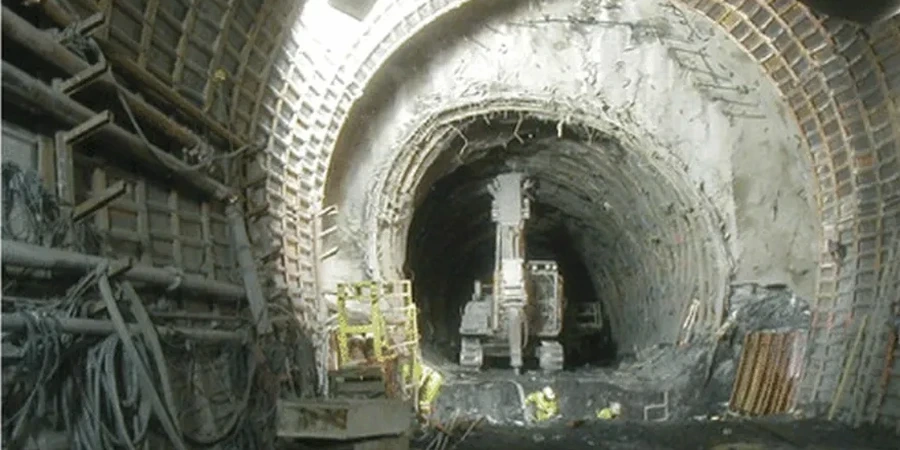
Tunnel projects in Savannah face a unique geological hurdle: the water table is only four to eight feet below the surface across most areas, and the Hawthorne Formation below contains artesian zones that can catch even veteran drillers off guard. When excavating a tunnel heading in soft, normally consolidated clay with high groundwater, the effective stress at the face decreases, and stand-up time can rapidly drop from hours to minutes. The upper 20 to 40 feet of sediment consist mainly of Holocene marsh and estuarine deposits, interspersed with loose fine sands that are susceptible to running ground conditions. Without thorough geotechnical analysis—incorporating undrained shear strength profiles and pore pressure predictions—the required face pressure for a TBM or sequential excavation method becomes a guess. While the deeper Duplin Formation is more competent, the transition zone between these two formations is where most instability issues occur in Savannah tunneling work.
Reference standards
Key ASTM standards applied include D1586 for Standard Penetration Test and split-barrel sampling, D2487 for Unified Soil Classification System, D2850 for Unconsolidated-Undrained Triaxial Compression Test on cohesive soils, D2435 for one-dimensional consolidation properties, and ASCE/SEI 7-22 for minimum design loads and tunnel seismic provisions.
Other technical services
Soft Ground Tunnel Soil Characterization Package
Our testing package involves complete index and strength testing on undisturbed samples from tunnel alignment borings. This includes USCS classification per ASTM D2487, Atterberg limits, natural moisture content, unit weight, unconsolidated-undrained triaxial (ASTM D2850), and one-dimensional consolidation (ASTM D2435). Each Shelby tube is logged at our Savannah facility, extruded cores are photographed, and a digital report with stratigraphic profiles keyed to tunnel stations is delivered. This package is tailored for open-face TBM and sequential excavation method projects where face stability relies on accurate undrained shear strength profiles through the Hawthorne and Duplin formations.
Tunnel Face Stability and Groundwater Analysis
A focused testing program is designed to evaluate stand-up time and running ground risk in Savannah's interbedded soft clays and loose sands. We conduct particle size distribution (ASTM D422/D6913) on sandy layers to check filter compatibility and piping potential, and perform remolded triaxial tests to bracket residual strength for face stability calculations. Consolidation testing on the softest clay layers helps predict long-term settlement beneath the historic district, where allowable differential settlement is often specified at less than half an inch. All test data is reported with chain-of-custody documentation suitable for GDOT and City of Savannah permit submissions.
Typical parameters
Frequently asked questions
What soil types in Savannah Georgia require the most attention for tunnel design?
The most challenging deposits are the Holocene marsh and estuarine sediments. These are typically soft, normally consolidated clays (CH per ASTM D2487) with undrained shear strengths between 500 and 1200 psf, interbedded with loose silty sands (SM) that are prone to running ground when the water table is high. The underlying Hawthorne Formation is more competent but contains artesian zones. The transition zone between Holocene deposits and the Hawthorne is where most face instability incidents occur in Savannah tunneling, requiring careful sampling and undrained triaxial testing for proper characterization.
How does the Savannah water table affect geotechnical analysis for tunnels?
In Savannah, the groundwater table is typically 4 to 8 feet below grade, but it fluctuates with tides, rainfall, and Savannah River stage. For tunnel analysis, this means the entire tunnel horizon is almost always below the water table. We perform consolidated-undrained triaxial tests with pore pressure measurement (ASTM D4767) to obtain effective stress parameters for sandy layers, and consolidation tests on clays to predict the time-rate of settlement. High groundwater also raises sample disturbance concerns, so we apply the Andresen and Kolstad criteria to assess Shelby tube quality before any strength testing begins.
What laboratory tests are essential for soft ground tunnel design in Savannah?
At a minimum, you need USCS classification (ASTM D2487) on every sample, Atterberg limits (ASTM D4318) on cohesive layers, undrained triaxial (ASTM D2850) for short-term face stability, and consolidation testing (ASTM D2435) for settlement prediction. If the alignment crosses sandy layers, particle size distribution (ASTM D422/D6913) is critical for assessing running ground potential. For deeper tunnels in the Hawthorne Formation, we also recommend drained triaxial testing (ASTM D4767) to obtain effective friction angles for long-term lining design. Our Savannah lab runs all these under ISO/IEC 17025 accredited procedures.
What is the typical cost range for geotechnical analysis of soft soil tunnels in Savannah?
For a comprehensive soft ground tunnel geotechnical analysis program in the Savannah area, costs typically range from US$3,850 to US$16,890, depending on the number of boreholes, sample depth intervals, and the testing suite required. A basic program with index testing and UU triaxial on 15 to 20 samples runs toward the lower end. A full program including consolidation, drained triaxial, and detailed stratigraphic reporting for a longer alignment with multiple formations falls at the higher end. Every quote includes chain-of-custody documentation and a digital report suitable for GDOT submittals.
How long does laboratory testing for a Savannah tunnel project take?
We align the testing schedule with the drilling program to allow simultaneous fieldwork and laboratory work as much as possible. For routine index tests—which include classification, Atterberg limits, and moisture content—the turnaround is 5 to 7 business days after sample receipt. Triaxial testing demands extra time because back-pressure saturation must be applied to Savannah's soft clays to prevent further disturbance; UU triaxial results are ready in 10 to 12 business days. Consolidation tests take the longest, 14 to 21 business days, since each load increment must reach primary consolidation, and Savannah's plastic clays have slow drainage rates.