Savannah sits barely 15 meters above sea level, and that low elevation tells you everything about the soil conditions. The coastal plain deposits here — loose sands, soft clays, and organic silts — create serious bearing capacity problems for any structure heavier than a single-story frame. We deal with this reality every week: conventional shallow footings fail the settlement criteria, and deep foundations blow the budget. Stone column design offers a middle path that works. By installing compacted gravel columns through the weak strata, we transfer loads to a composite ground mass with improved stiffness and drainage. For projects near the Savannah River or out toward Pooler, where the water table sits barely 1.5 meters down, the drainage function alone prevents pore pressure buildup that would otherwise trigger long-term settlement. We combine the stone column approach with in-situ permeability data to confirm that radial drainage is actually working as designed — without it, you are guessing on consolidation rates.
A well-designed stone column grid cuts consolidation time from years to weeks while doubling the bearing capacity of Savannah’s coastal soils.
Process and scope
Local ground factors
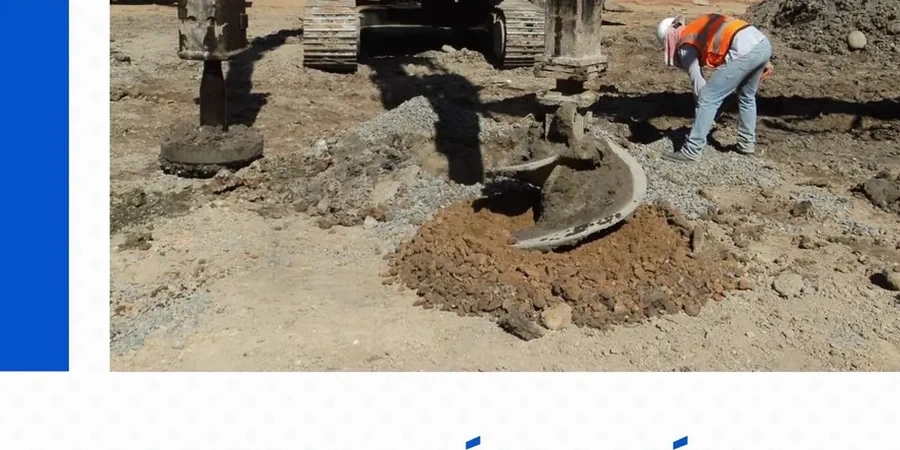
In Savannah, one of the costliest errors involves contractors treating stone columns as a uniform product without accounting for subsurface variability. The coastal plain's geology demands tailored designs. For instance, a layout optimized for stiff clays under Historic District buildings can see performance drop by 40% or more when applied to compressible organic silts near the Vernon River. CPT logs from adjacent lots just 30 meters apart show a 5-meter difference in depth to competent bearing strata, necessitating lot-by-lot column length adjustments rather than reusing past designs. Another frequent mistake is selecting the wrong aggregate gradation; fines over 5% clog the column and impair drainage. We specify ASTM D448 No. 57 stone with strict wash requirements, verified at the batch plant before any load leaves. Given the typically high water table, wet top-feed installation with a vibrating probe is the sole method that reliably achieves required compaction without borehole collapse.
Video overview
Reference standards
Our designs incorporate FHWA-NHI-06-086 for ground improvement methods, ASTM D1586 for SPT site characterization, ASTM D2487 for soil classification, ASTM D448 for aggregate gradation, and the Priebe method with the Baez 1995 modification for settlement analysis.
Other technical services
Stone column design package
A Georgia-licensed professional engineer stamps the final package, which includes full engineering calculations using the Priebe method correlated with CPT/SPT data, column layout drawings, aggregate specifications, installation sequence, and a construction QC/QA plan.
Post-installation verification testing
Post-installation verification involves CPT soundings between columns to confirm the improvement factor, plate load tests up to 250 kPa reaction capacity, and settlement monitoring during consolidation. We compare measured and predicted settlements to issue the final acceptance report.
Typical parameters
Frequently asked questions
How much does stone column design cost for a typical Savannah commercial site?
Design package costs for Savannah-area commercial lots—such as warehouse pads, retail buildings, or low-rise offices—range from US$1,600 to US$4,680, depending on boring count, soil profile complexity, and whether post-installation verification is included. A simple single-building site with two borings and uniform soil is at the lower end, while a multi-structure development near the river with variable stratigraphy and lateral spreading concerns pushes toward the upper end.
How do stone columns compare to deep foundations for Savannah coastal soils?
Stone columns are cost-effective for weak zones less than 15 to 18 meters deep in the Savannah coastal plain because they improve the ground mass rather than bypassing it, also providing drainage to reduce post-construction settlement—unlike driven piles. However, if the compressible layer exceeds 20 meters or structural loads require point bearing on rock, deep foundations are preferable. During feasibility, we evaluate both options using CPT data and load estimates.
What soil types in Savannah are suitable for stone column ground improvement?
Optimal stone column performance occurs in soft to medium clays with undrained shear strength above 15 kPa, loose silty sands, and mixed alluvial deposits—common across Savannah and Chatham County. They are less effective in peat, organic soils with loss-on-ignition above 15%, or very soft clays below 10 kPa where lateral confinement is insufficient. Before finalizing a design, we run Atterberg limits and organic content tests on every sample.
How long does the stone column design and installation process take?
Design typically takes 10 to 15 business days after receiving the final geotechnical report. Field installation for a standard 1,500-square-meter site with one rig runs 5 to 8 working days. Post-installation verification—CPT and plate load tests—requires an additional 2 to 3 days. Consolidation monitoring may extend 4 to 8 weeks, depending on drainage path length and the client's schedule tolerance.